Civil, Commercial & Property Litigation in Delhi
Civil, Commercial & Property Litigation in Delhi: Legal Remedies, Court Proceedings and Strategic Considerations
Property Disputes/
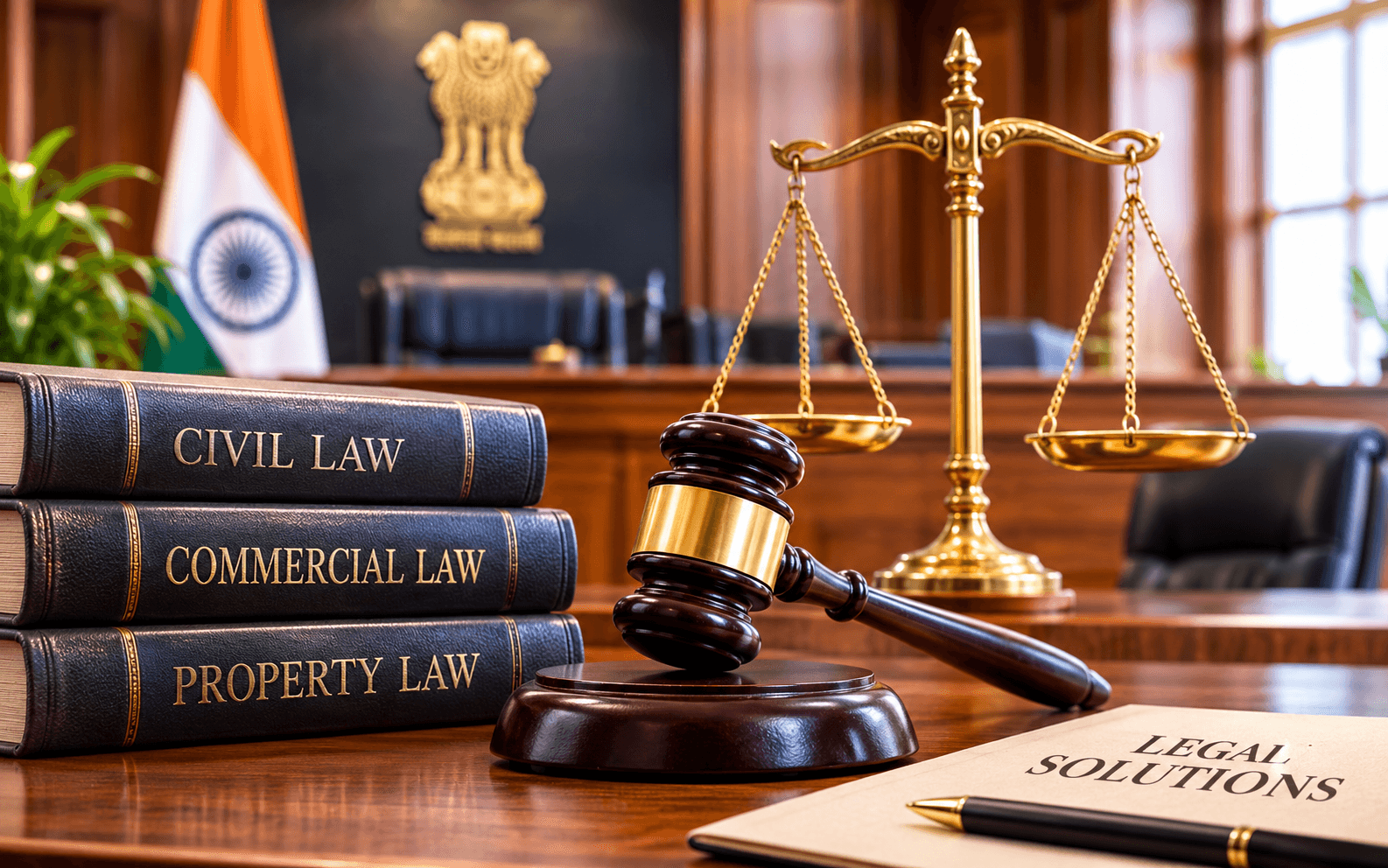
Civil, Commercial & Property Litigation in Delhi: Legal Remedies, Court Proceedings and Strategic Considerations
Civil, commercial and property disputes are among the most common forms of litigation involving individuals, property owners, businesses and corporate institutions. Such disputes may arise from contractual disagreements, property ownership, illegal possession, financial transactions, business obligations, inheritance, partnership arrangements or non-compliance with legal agreements.
In Delhi, resolving these disputes often requires a thorough understanding of civil procedure, applicable statutory provisions, documentary evidence, limitation periods and the jurisdiction of competent courts.
Whether the matter concerns recovery of money, possession of immovable property, contractual enforcement, partition, commercial recovery or a property-related injunction, choosing the appropriate legal remedy and preparing a sound litigation strategy are essential.
1. Understanding Civil Litigation in Delhi
Civil litigation refers to legal proceedings initiated before competent courts or judicial forums for the enforcement of civil rights, resolution of private disputes and protection of legally recognised interests.
Civil disputes may involve individuals, families, property owners, landlords, tenants, businesses and other legal entities.
Common civil litigation matters include:
- Recovery suits and money recovery proceedings.
- Suits for declaration and permanent injunction.
- Mandatory injunction and possession proceedings.
- Partition and inheritance disputes.
- Specific performance of contracts.
- Landlord-tenant and eviction disputes.
- Cancellation of sale deeds and other instruments.
- Breach of contractual obligations.
- Execution of decrees and enforcement proceedings.
Civil proceedings are primarily governed by the Code of Civil Procedure, 1908, along with the relevant substantive laws applicable to the dispute.
2. Property Disputes and Property Litigation
Property disputes frequently involve questions concerning ownership, possession, title, inheritance, transfer of property and contractual obligations.
Property litigation in Delhi may arise from transactions involving residential properties, commercial premises, ancestral properties, jointly owned properties and other immovable assets.
Some common property-related disputes include:
A. Property Ownership and Title Disputes
Disagreements concerning ownership, title documents, competing claims and the validity of property transactions may require civil adjudication.
B. Illegal Possession and Encroachment
Where a person is unlawfully occupying or interfering with another person's property rights, appropriate civil remedies may include possession proceedings and injunctions, depending upon the facts and legal entitlement.
C. Property Partition and Inheritance
Disputes among co-owners, family members and legal heirs concerning division of property may require partition proceedings or other appropriate legal remedies.
D. Sale Deed and Property Document Disputes
Disputes involving fraudulent documentation, cancellation of instruments, defective transactions, disputed agreements and challenges to registered documents may require examination of the applicable provisions of property and registration laws.
E. Builder-Buyer and Real Estate Disputes
Disputes involving delayed possession, contractual violations, refund claims, construction deficiencies and other builder-related issues may attract remedies under the Real Estate (Regulation and Development) Act, 2016, consumer protection laws or civil law, depending upon the nature of the dispute and available statutory remedies.
3. Commercial Litigation and Business Disputes
Commercial litigation involves disputes arising from business transactions, contractual relationships, financial obligations and commercial activities.
Businesses and corporate entities may encounter legal disputes involving customers, suppliers, contractors, business partners, lenders and other commercial stakeholders.
Common commercial disputes include:
- Recovery of outstanding business payments.
- Breach of commercial agreements.
- Contractual disputes and non-performance.
- Partnership and shareholder disputes.
- Financial and banking disputes.
- Supply and service-related disputes.
- Business transaction disputes.
- Enforcement of contractual obligations.
- Arbitration-related litigation.
- Commercial recovery proceedings.
The Commercial Courts Act, 2015 provides a specialised framework for adjudication of qualifying commercial disputes of specified value before designated Commercial Courts and Commercial Divisions.
An important procedural consideration is Section 12A of the Act, which generally requires pre-institution mediation before filing a qualifying commercial suit that does not contemplate any urgent interim relief.
Businesses should therefore assess the nature of their dispute, applicable jurisdiction, specified value requirements and procedural obligations before initiating commercial litigation.
4. Important Legal Remedies in Civil and Property Litigation
The appropriate legal remedy depends upon the nature of the dispute, the rights involved, available documentary evidence and applicable statutory provisions.
Some important remedies include:
Suit for Recovery: A civil remedy for recovering outstanding money or other legally recoverable amounts.
Suit for Possession: Proceedings seeking recovery of immovable property from a person who is not legally entitled to retain possession.
Suit for Permanent Injunction: A remedy to restrain a defendant from continuing or repeating an act that interferes with the plaintiff's legally protected rights.
Suit for Mandatory Injunction: Proceedings seeking directions requiring a person to perform a particular act where the legal requirements are satisfied.
Suit for Declaration: Proceedings seeking a judicial declaration concerning the legal character or status of a person or a right in property.
Suit for Specific Performance: A remedy seeking enforcement of contractual obligations in accordance with the Specific Relief Act, 1963, subject to its statutory requirements.
Partition Proceedings: Legal proceedings seeking division of jointly owned property in accordance with the respective legal rights of the parties.
Arbitration: Where a valid arbitration agreement exists and the dispute is legally arbitrable, arbitration may provide an alternative mechanism for resolving commercial and contractual disputes.
5. Importance of Documentary Evidence in Litigation
Documentary evidence plays a significant role in civil, commercial and property litigation.
Before initiating legal proceedings, it is important to identify, preserve and examine relevant documents.
Depending upon the nature of the dispute, these may include:
- Sale deeds and conveyance deeds.
- Agreements to sell and other contractual documents.
- Property title documents and registration records.
- Payment receipts and bank transaction records.
- Invoices and business correspondence.
- Loan agreements and financial statements.
- Notices and replies exchanged between parties.
- Possession-related documents.
- Relevant electronic records and communications.
The authenticity, admissibility, relevance and evidentiary value of documents must be examined in accordance with applicable law, including the Bharatiya Sakshya Adhiniyam, 2023, wherever applicable.
A properly documented case can assist in identifying material issues, assessing the strength of the legal claim and preparing appropriate pleadings.
6. Civil and Commercial Litigation Procedure in Delhi
Although the procedure varies according to the nature of the dispute, civil and commercial litigation generally involves several important stages.
Stage 1 – Preliminary Legal Assessment
Examination of the factual background, legal rights, documents, limitation and jurisdiction.
Stage 2 – Legal Notice and Pre-Litigation Resolution
Where appropriate, a legal notice, negotiation, mediation or settlement process may be considered before commencing litigation.
Stage 3 – Drafting and Filing of the Suit
Preparation and filing of the plaint, supporting documents and relevant applications before the competent court.
Stage 4 – Written Statement and Pleadings
The defendant is provided an opportunity to respond in accordance with applicable procedural provisions.
Stage 5 – Framing of Issues and Evidence
The court determines the issues requiring adjudication and the parties lead their respective evidence.
Stage 6 – Final Arguments
The parties present their legal submissions based on pleadings, evidence, applicable legislation and judicial precedents.
Stage 7 – Judgment and Decree
The court adjudicates the dispute and passes appropriate orders or decrees.
Stage 8 – Execution, Appeal or Other Remedies
Depending upon the circumstances, execution proceedings, appeals, revisions or other legally available remedies may be pursued.
7. Why Timely Legal Advice Matters
Delay in seeking appropriate legal advice can create procedural and substantive difficulties.
Limitation periods, territorial and pecuniary jurisdiction, availability of interim relief, documentary evidence and applicable statutory requirements should be assessed at an early stage.
For example, a property dispute may require immediate consideration of interim injunctions, whereas a commercial recovery matter may require examination of contractual terms, invoices, payment records and pre-institution mediation requirements.
A case-specific legal assessment can help identify the appropriate remedy and avoid unnecessary procedural complications.
8. Choosing the Right Civil, Property and Commercial Litigation Advocate in Delhi
Selecting an advocate for civil, commercial or property litigation requires consideration of the nature of the dispute and the relevant area of legal practice.
Important considerations include:
- Understanding of applicable civil and commercial laws.
- Experience in handling relevant categories of litigation.
- Knowledge of court procedures and jurisdiction.
- Ability to examine documentary and electronic evidence.
- Legal research and drafting capabilities.
- Assessment of available remedies and procedural risks.
- Professional communication and ethical responsibility.
Every dispute has its own factual and legal circumstances. Accordingly, legal advice and litigation strategy should be based on the individual merits of the matter rather than a standard approach.
9. Civil, Commercial and Property Litigation Services at Gaur's Law Firm (LLP), Delhi
Gaur's Law Firm (GLF), operating as GAUR'S LAW LLP, is a Delhi-based legal practice providing legal consultancy, litigation assistance and professional legal representation across diverse areas of law.
Led by Advocate Yogesh Gaur, Founder & Managing Partner, the firm has a multidisciplinary team of Advocates with experience across Civil Litigation, Property Disputes, Financial Disputes, Commercial Litigation, Company & Corporate Law, RERA Matters, Arbitration, Criminal Litigation and Matrimonial & Family Law.
With its professional office at Cross River Mall, near Karkardooma Court Metro Station, Delhi, the firm handles appropriate legal assignments across Delhi and the wider Delhi-NCR region, subject to applicable jurisdictional requirements.
Our approach emphasises:
- Detailed examination of facts and supporting documents.
- Research-oriented legal assessment.
- Appropriate drafting of pleadings and applications.
- Strategic preparation for court proceedings.
- Assessment of interim and final legal remedies.
- Professional consultation and dispute resolution.
- Consideration of settlement and non-litigation alternatives wherever appropriate.
We believe that effective legal representation is founded on professional integrity, thorough preparation and a clear understanding of the client's legitimate legal interests.
10. Frequently Asked Questions (FAQs)
Q1. Which court handles civil property disputes in Delhi?
The competent court depends upon territorial jurisdiction, pecuniary jurisdiction, the nature of the relief sought and applicable statutory provisions. Certain disputes may also fall within specialised statutory forums.
Q2. What legal action can be taken against illegal possession of property?
Depending upon the facts, ownership or possessory rights and applicable law, remedies may include a suit for possession, permanent injunction, mandatory injunction or other appropriate proceedings.
Q3. What is commercial litigation?
Commercial litigation involves disputes arising from business transactions, commercial contracts, financial obligations, partnerships and other qualifying commercial relationships.
Q4. Is a legal notice mandatory before filing every civil suit?
No. A legal notice is not universally mandatory before every civil suit. However, specific statutes, contractual provisions and particular categories of proceedings may require prior notice or compliance with other pre-litigation procedures.
Q5. What is the importance of Section 12A of the Commercial Courts Act, 2015?
Section 12A generally requires pre-institution mediation in qualifying commercial disputes that do not contemplate urgent interim relief. Its applicability should be assessed before filing the suit.
Q6. Can a property dispute be resolved without filing a court case?
Yes. Depending upon the nature of the dispute, parties may consider negotiation, mediation, family settlement or other legally permissible settlement mechanisms.
Q7. Which documents are required for a property dispute?
Relevant documents may include title deeds, sale deeds, agreements, registration records, payment documents, possession records, correspondence and other evidence supporting the legal claim.
Conclusion
Civil, commercial and property disputes require careful legal assessment, appropriate documentation and a well-considered litigation strategy. Understanding the available remedies, applicable procedural requirements and jurisdiction of the competent forum is essential before initiating legal proceedings.
Whether the matter involves property ownership, possession, contractual enforcement, commercial recovery or civil injunctions, obtaining appropriate legal advice at the right stage can help protect legitimate legal rights and interests.
GAUR'S LAW FIRM (GLF) | GAUR'S LAW LLP
A Group of Advocates, Solicitors & Legal Consultants
Founder & Managing Partner: YOGESH GAUR (ADVOCATE)
Office: SF-04, Second Floor, Cross River Mall, Near Karkardooma Court Metro Station, Delhi – 110032, India.
Phone: 9871434271
Email: gaurlawfirm09@gmail.com
Website: www.gaurlawfirm.com
Disclaimer: This article is published for general informational and educational purposes only. It does not constitute legal advice or create an advocate-client relationship. The applicability of legal provisions and remedies depends upon the facts and circumstances of each case. Readers should obtain appropriate professional legal advice before taking any legal action.
Have a matter you would like to discuss?
Get in touch with our team to discuss your specific situation.